

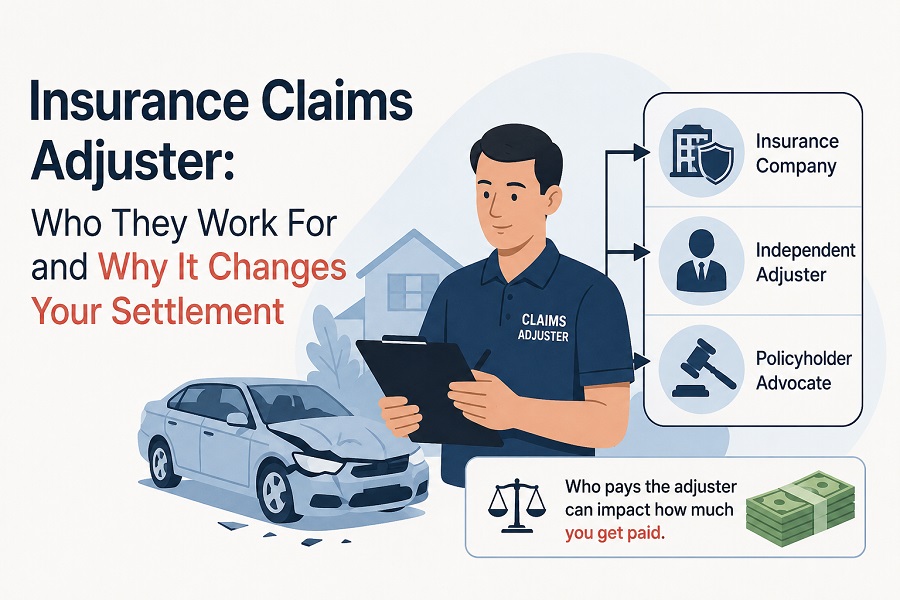
Every property insurance claim involves an insurance claims adjuster. What most policyholders do not realise is that the title covers three very different roles, and the difference between them determines whose interests are being protected during your claim.
The Three Types of Insurance Claims Adjusters
Staff adjusters are direct employees of the insurance company. Independent adjusters are contractors hired by insurers, often to handle claim volume after major events. Despite the word independent, they are paid by and answer to the insurance company.
An insurance public adjuster is the only category licensed to represent the policyholder. In California, public adjusters are licensed and regulated under the Insurance Code [1], work on a contingency basis, and owe their duty entirely to the policyholder, not the insurer.
Why the Distinction Affects Your Outcome
The adjuster’s employer shapes the assessment. An adjuster working for the insurer evaluates the claim within the insurer’s cost framework. Their scope of loss may not include hidden damage, code upgrade requirements, or the full business interruption period, categories that routinely represent a significant share of the actual loss.
A public adjuster approaches the same loss from the policyholder’s side: identifying every applicable coverage in the policy, documenting the complete scope of damage including what is not visible, and negotiating from that documented position.
Your Rights During the Claims Process
California’s Fair Claims Settlement Practices Regulations require insurers to acknowledge claims within 15 calendar days, respond to communications within 15 calendar days, and accept or deny claims within 40 days of receiving proof of loss [2]. Policyholders also have the right to hire their own representation at any stage of the claim, including after a denial or an initial settlement offer.
Firms such as Allied Public Adjusters are frequently engaged at these later stages, reviewing what the insurer’s adjuster documented and identifying where the claim can be strengthened, supplemented, or challenged.
Key Takeaways
|
1 |
Staff and independent adjusters both work for the insurance company. Only a public adjuster represents the policyholder. |
|
2 |
The adjuster’s employer directly shapes what gets included in the scope of loss. |
|
3 |
California insurers must acknowledge claims within 15 calendar days and decide within 40 days of proof of loss. |
|
4 |
Policyholders can engage their own representation at any stage, including after a denial. |
|
5 |
Hidden damage, code upgrades, and business interruption are the categories most often missing from insurer-side assessments. |
References
[1] California Insurance Code, Sections 15000-15055 (public adjuster licensing). California Legislative Information, leginfo.legislature.ca.gov
[2] California Code of Regulations, Title 10, Sections 2695.5 and 2695.7, Fair Claims Settlement Practices Regulations. California Department of Insurance
